


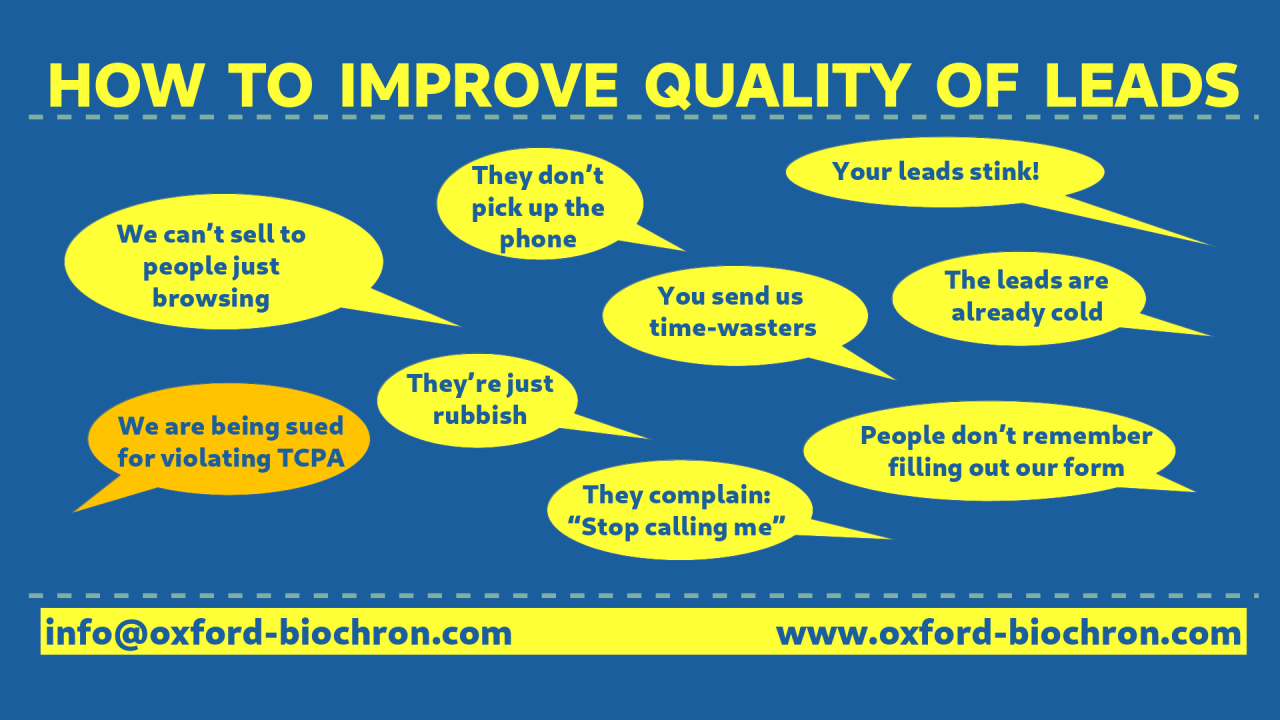
Sales claims that the marketing qualified leads (MQLs) stink! As a marketer you know the leads should be okay. So, what are they complaining about? What can you do, as a marketer, to objectively establish the quality of your generated leads? And where, what and how can you improve them? Without returning the argument to sales (or your call center) that they should do better in order to close deals!
When running a single or, more likely, multiple B2C campaigns concurrently to attract new visitors at scale you eventually generate tons of leads. But, how do you ensure that those leads have value? That they are quality leads? But, then again what is quality? The industry’s answer is MQLs, but what does that mean? That someone submitted an email address and/or phone number? From an IP address in the targeted geo? That’s a bit meager.
So, what’s the answer?
The answer can be found by looking at Oxford Biochronometrics ’ experience with their clients and how these clients have successfully structured and optimized their processes to ensure that the leads they generate have proper quality. So far Oxford Biochronometrics has protected and validated billions of generated leads. At that scale you’ll get a good overview what happens in the ecosystem, what problems clients encounter and how they manage to solve these problems, how paid traffic behaves at scale, how fraud changes and evolves over time, where to look and what to do when you find statistical outliers in traffic patterns and/or campaign results that don’t match expectations.
First let’s take a few steps back to see what possible information is available and could be used to determine quality. Also, there’s only one requirement: Your lead generation pages need to be hosted at domains that you control, otherwise the data cannot be fully trusted.
The first party information available:
The journey. How did the visitor arrive at your digital doorstep?
The device and its properties
The information submitted by the user, ie. the web form content (the lead gen info)
From where? IP address to geo-location
Marketing related information (campaign, source, medium, etc)
Other info (time of day, duration, etc)
Third party information:
Verification services checking and validating the submitted information
Fraud detection to determine genuine (human) or fraud (bot, human operated fraud, etc)
Behavioral interaction scoring of the prospect filling out the lead gen form
The Journey
How did a visitor arrive can be determined by looking at utm_**** values, or cookies set by third parties. This enables you to understand how the user traversed the Internet and arrived at your landing page. It prevents fraudulent leads that claim to be coming from a source and directly submit the lead generation form.
Device
The operating system of the device, the browser type (based on user agent and feature extraction), mobile or desktop, screen size, colors, time zone, languages give you an understanding what type of devices arrived at your landing page. If you target mobile you also expect to see mobiles.
Form field info
At your landing page the JavaScript already prevented empty or partially filled forms to be submitted. But, when these basic checks are passed and you do receive the form content you still have to do some sanity checks, eg. Mickey Mouse Disneyland wouldn’t be a real customer. Also leads with phone numbers starting with for example area codes 555 or 911 aren’t real.
From where?
Use an up to date IP address to geo-location service to see whether the lead was generated within your targeted geo.
Marketing information
Almost all generated leads come from a paid source. The marketing information associated to a generated lead are: source, campaign, medium, search terms, content. Check if these values exist and cross validate the journey prior to arriving at your landing page.
Other information
The time of the day and visit duration will show time related trends and outliers.
Third party information
Besides these basic checks you should use 3rd parties to validate the submitted data, technical data of the visit and the visitor’s behavior while filling out the lead generation form.
Verification services (3rd party)
When a generated lead looks good you can use a third party to verify whether the information is correct. Does this name belong to the driver’s license ID, does the name live on this address, etc?
Email reputation services (3rd party)
Another type of verification service is to check the email domain reputation. Although this can be avoided easily by fraudsters. You can also check it yourself by breaking down email domains per traffic source, campaign, etc. to see whether a source or campaign looks statistically okay.
IP address reputation services (3rd party)
This type of service can be called in order to know whether an IP address often is used as (residential) proxy, VPN endpoint, data center IP address, or otherwise is known for fraudulent activity.
Oxford Biochronometrics fraud detection
This fraud detection checks for bot signatures and browser automation frameworks, but not all fraud comes from bots. Human operated fraud and malicious AI agents are more prevalent in lead generation, as the earnings are high enough to cover the costs. Fraud detection enables you to verify whether the form was submitted by a real human. If not, dismiss the lead.
Oxford Biochronometrics behavioral interaction
Filtering out leads that are fraudulent, phony, fake or bad leaves you with the genuine leads. These leads can be followed up safely. But, as we all know some leads more likely convert than other leads. And the question is: “Can this be known upfront?”. Because, if you know this upfront, you can prioritize the leads that convert more likely. It is well known that speed to lead works in favor of converting a lead to a sale. Using the interactional behavior of the person who filled out the form to prioritize leads enables you to follow up high intent leads more quickly before the prospect loses focus or buys somewhere else.
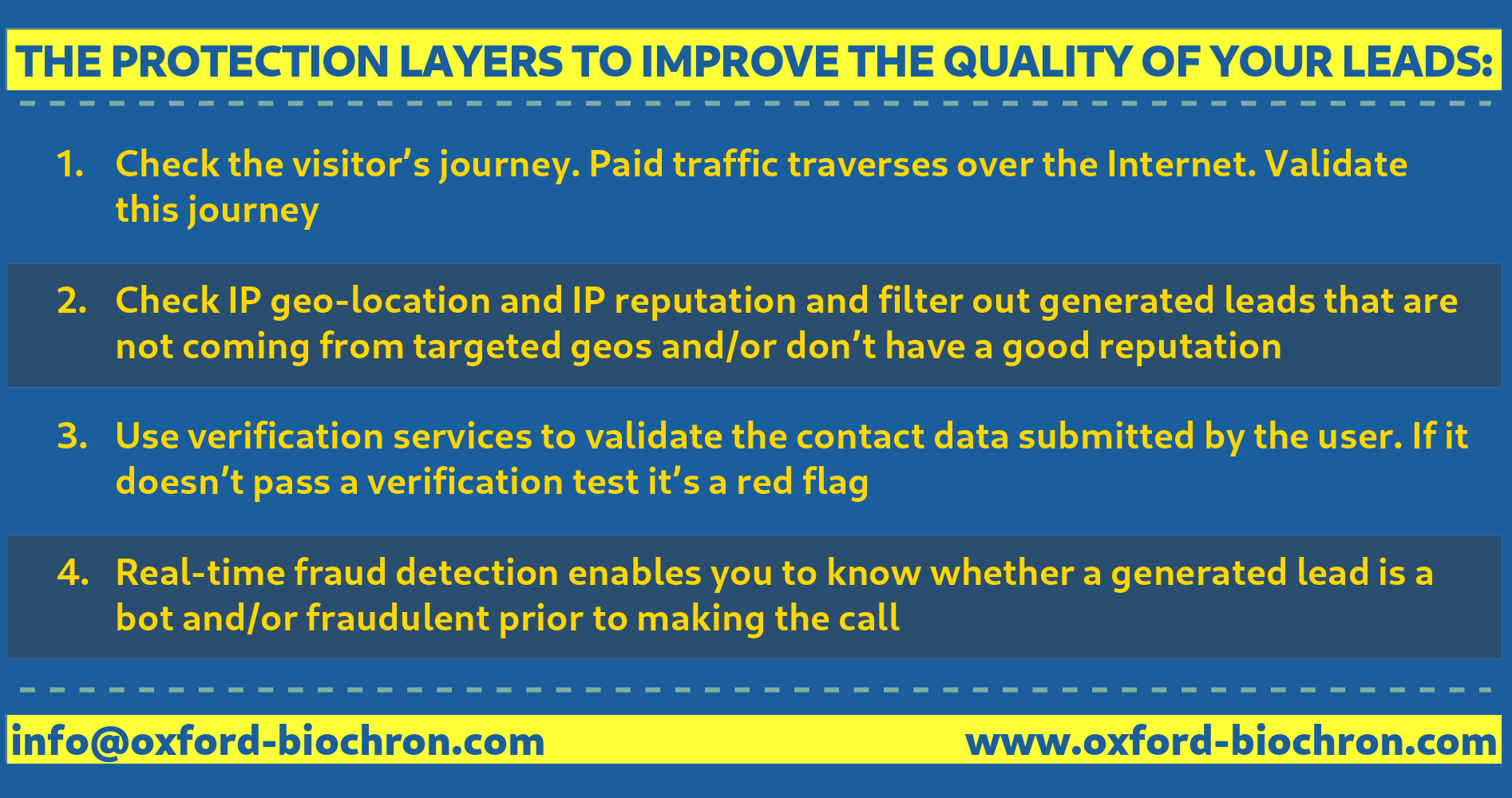
The combination of these layers in order to remove bad leads, phony leads, fake leads, fraudulent leads, etc. improves the overall quality of the remaining leads and thus the overall performance.
Practically, how do you combine these layers of information in order to protect and improve the quality level of your generated leads:
Check the journey. When running campaigns your traffic is mostly paid and has a journey and source. Only a small percentage organic traffic can be expected.
Check the IP geo-location and IP reputation and filter out generated leads that are not coming from targeted geos and/or have a good reputation.
Use verification services to validate the contact data submitted by the user. If it doesn’t pass a verification test it’s a red flag.
Real-time fraud detection is used to know whether the generated lead is fraudulent. If so, ignore the lead.
As a bonus prioritize leads based on how the human interacted with the form while filling it out.
The leads that remain are put into your CRM (or a working queue) to be contacted by your call center or sales. In addition you can prioritize the leads by ranking the leads on their interactional behavior score. This enables you to contact high intent leads earlier and increasing the overall result.
We really like your service, and want to extract as much value as possible (its one of the cleanest and most useful signals we have on our leads today) -- a happy insurance customer
If you run ad campaigns you buy impressions (CPM) you can expect fraudulent/ fake impressions (ad fraud). If you buy per click (CPC) you can expect fraudulent/ fake clicks. If you buy leads (CPL) you can expect fraudulent/ fake leads. This doesn’t mean that lead generation fraud only happens when you buy leads (CPL). Nope, unfortunately not. But, the good thing about CPL over CPC and CPM is that your can return fraudulent leads free of charge to your source. The fraud now becomes a problem for the lead generator.
Conclusion
Once you have removed all the bad leads from the generated leads you can objectively measure your campaign’s output. It enables you to understand whether a campaign works, how different campaigns score against each other. It also creates clean A/B tests on your landing pages, because fraud and bots don’t care about that, but humans are influenced by A/B tests and thus the output is clean. Without the bad and fraudulent parts you are actually optimizing your campaigns towards humans. You will again understand why campaigns work (or not) work based on human response.
Digital marketing has already many moving parts. When using data from your campaigns without filtering the invalid parts you just don’t know whether your creatives are not attractive enough, your landing page is the problem, your campaign was shown to the wrong audience, etc. But, after filtering out bad, phony, fake, and fraudulent leads you at least have a clean dataset to answer your questions.
Invalid traffic poisons the information you use to manage and allocate your next round of marketing budget. It also causes low quality leads which are time wasters and potential litigation risks. The cumulative effect is significant. So, filter out the bad leads, the invalid leads, the fraudulent leads, the phony leads and the ones out of geo using the list above.
If you need help filtering out bad, poor, fake, phony and/or fraudulent generated leads in real-time and need help to prioritize high intent leads, Oxford Biochronometrics can help.
Want more info? Comments? Other questions? Let me know, feedback is appreciated. Likes and reposts are also appreciated.
#leadgeneration #leadgen #CMO #digitalmarketing #adfraud #verifiedleads
Glossary
B2C - business to consumer
CRM - customer relationship management
CPM - cost per mille
CPC - cost per click
CPL - cost per lead
MQL - marketing qualifies lead
VPN - virtual private network
First publish date: 2026-Sep-10