


We all love conspiracy theories. Some are obsessed with them, some will laugh about them, some ridicule them, and some others just ignore them. The dead Internet theory is such a conspiracy theory.
Somewhere in 2016/ 2017 someone claimed that “the vast majority of activity on the Internet was automated (bots) manipulated by an algorithm for the purpose of manipulating the population of the world for [insert reason]” [1][2]. In 2021 a lengthy post was written called “Dead Internet Theory: Most Of The Internet Is Fake” suggesting that AI drowned out the majority of human activity [3].
Looking at the first quote it appears that ‘manipulation’ does have a negative connotation. But, without this negativity it sounds what marketing tries to achieve, ie. planting a seed in someone’s mind hoping that once that someone is ready to buy a product that someone remembers and buys the product that was advertised.
But, the most crucial component of the digital advertising ecosystem is eroding away. So, what are the players in the ecosystem doing to overcome this? That’s what this dead digital advertising conspiracy theory is about.
Digital advertising ecosystem
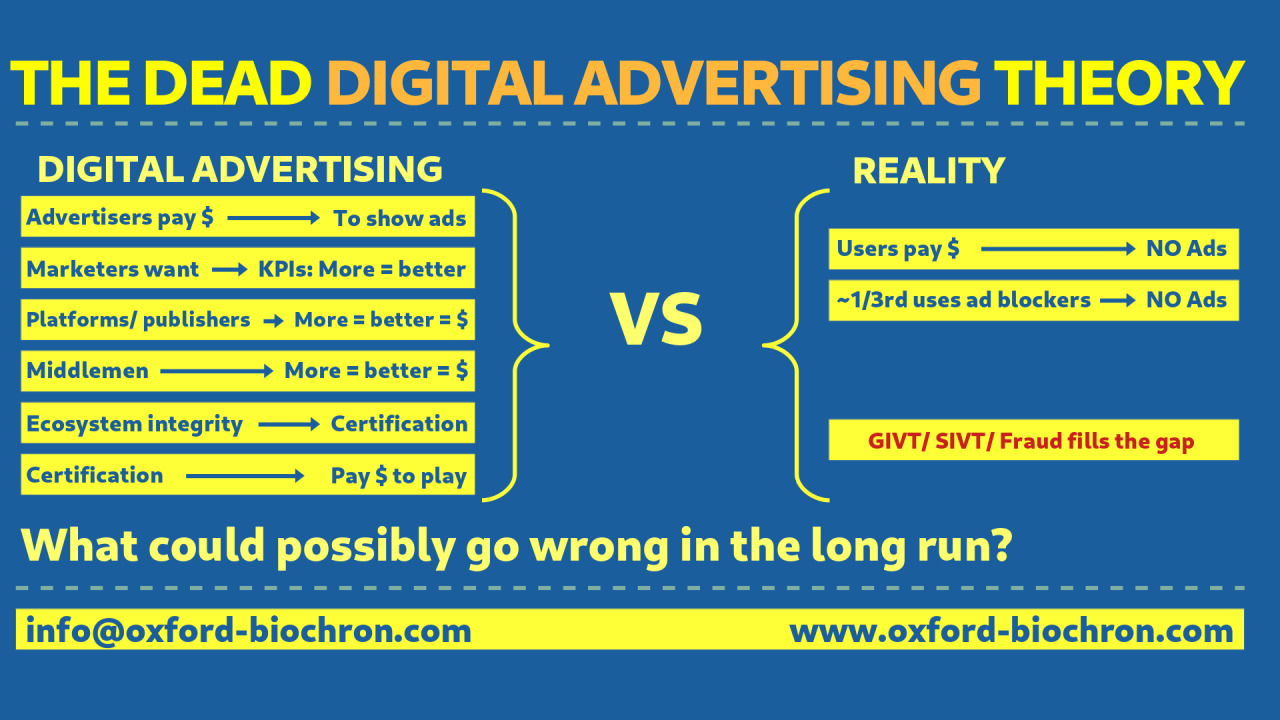
When you look at the incentives of the players in the digital marketing ecosystem you see an interesting pattern emerge. Advertisers pay publishers and platforms to show advertisements, whereas consumers pay these publishers and platforms to have an ad-free experience (subscriptions). A large group of users uses ad blockers, VPNs with built-in ad blocking, or many other ways to block and avoid ads [4].
The platforms and/or publishers and/or many websites with advertisements need to have a minimum number of monthly active users, ie. more than the previous quarter and/ot the same quarter last year. This number is sold as the fertile ground upon which advertisers can plant their seeds. The underlying question is: Do the platforms reliably know you are human or not? And do they care? And why would they care?
Marketers monitoring their campaigns look at metrics that tell the number of impressions, clicks, leads, etc. without knowing whether a bot or a human did see the impression, fire the click, submit the lead, etc. But, if some threshold is reached the campaign was successful! Again, the question is: Do these marketers reliably know you are human or not? And do they care? And why would they care?
The middlemen in the ecosystem take care of running the ad exchanges, ad auctions, targeting, audience profiling, and tracking, etc. They make the match between advertiser’s inventory (supply) and potential users (demand) based on audience profiles. Again, the question is: Do these middlemen reliably know you are human or not? And do they care? And why would they care?
Post-bid verification of advertisements is an additional step to really really guarantee that only humans loaded, viewed and clicked on advertisements. This is typically charged per volume, the more the better! Again, the question is: Do these middlemen reliably know you are human or not? And do they care? And why would they care?
How do advertisers know these parties listed above don’t cheat and collaborate with nefarious parties in order to inflate their numbers, and/or mix cheaper (bot)traffic into the ecosystem, or [insert many reasons here]? After all, the incentive of these parties is to make money, reach the quarterly targets to please shareholders while trying to minimize costs.
In order to guarantee integrity and quality a certification program has emerged to ensure that companies are trustworthy, can be held accountable, are transparent and have the knowledge to improve the ecosystem when things go wrong. To get a certification you only have to pay an annual amount to be certified and keep on paying to stay certified. What does this certify guarantee? You get listed in an online registry. Secondly, it guarantees that the staffing and procedures of the certified company are in order. Anything about quality assessment or minimal requirements of the technology to detect GIVT, SIVT and fraud, because after all you wouldn’t let a > $500 billion/year ecosystem left unprotected? Nope.. [5]

Dead digital advertising theory
The refresher above showed you the major players in the digital advertising ecosystem and how these players are dependent on each other and the misalignment between humans (the crucial and finite resource) and the ecosystem.
With the rise of AI agents human usage patterns will change as well. Targeting a human to plant the seed for a future sale? How do you know this human isn’t an AI agent performing its daily grabbing of news articles, and/or product prices to find the cheapest option and availability?
Google used to have a symbiotic relation with the websites they scraped because Google generated traffic, ie. visitors that searched for keywords relevant to your website. That’s why their crawler bots were considered ‘good bots’. But now that game has changed.
On May 19th 2026, at I/O Google, Google revealed that 58% of the searched do not end with a click [6]. Google processes between 8.5 and 14 billion search queries a day [7]. Google’s primary business model has been getting paid for the clicks on the sponsored links. But, with an AI that already answers your query Google Search changes from a list with links to AI summaries.
Less visitors clicking through to the websites that created the content means less page view, thus less advertisements, and thus less income for these websites’ owners. They originally created the content that was scraped and ingested into the AI models and now that works against them.
Although it also means less clicks on sponsored results in Google’s AI overview, but I assume that at some point you, as a brand, will have the option to pay to be mentioned into AI responses. And the more you pay, the more recommended you will be.
Conclusion
In short:
Advertisers pay platforms and publishers to show their advertisements.
Platforms and publishers need to show an increasing number of monthly active users.
The middlemen in the ad ecosystem need more consumers to sell more advertising space.
Middlemen, platforms pay to be certified (anti-fraud, brand safety, malvertising, transparency)
Filtering out fraud (prebid and postbid) directly conflicts with the incentives b) and c).
Consumers pay subscriptions to NOT see any advertisements.
Users use ad-blockers to BLOCK (intrusive) advertisements
AI search will change how users traverse the Internet, what content they consume
AI agents will change how users interact with web shops and lead generation forms.
The usage pattern of how people use the Internet is going to change. Google Search has already changed from presenting a list of hyperlinks associated to your Geo and search terms to an AI generated response. Most people consume this response only, and rarely click trough to the source page.
The (free) Internet is built upon advertising. If you look at the quarterly numbers you see that Google (Search and Youtube) [8], Meta (Facebook and Instagram) [9], TikTok get most of their revenue from digital advertising. The open Internet is declining and most websites need visitors to generate some revenue by showing advertisements. Besides the most visited websites, how will all these smaller websites attract visitors now Google search changed? and AI Agents only scrape the information instead of humans consuming content?
Will the total advertising space will shrink? I mean not technically or in bandwidth, but in human volume. Will the players in the ecosystem continue to sell more, more and more at the same growing rate? Or will the ecosystem run out of humans and will the costs go up?
Advertisers are not dead. The ground of the digital advertising ecosystem is losing its fertility. Hence this theory. Now, do you think the fraud problem in the online advertising will decrease or increase? What will your action plan be to protect your marketing spend against this? Do you know, as a brand and as an advertiser, what your options are? You should. Because, you’re paying for it.
DM me or Oxford Biochronometrics to learn more.
Glossary
GIVT General InValid Traffic
SIVT Sophisticated InValid Traffic
Sources
[1] https://www.forbes.com/sites/danidiplacido/2024/01/16/the-dead-internet-theory-explained/
[2] https://en.wikipedia.org/wiki/Dead_Internet_theory
[4] https://www.emarketer.com/learningcenter/guides/ad-blocking/
[5] https://www.tagtoday.net/hubfs/CAF/TAG%20CAF%20Guidelines%20Final.pdf
[6] https://www.thestateofbrand.com/news/google-just-killed-search-as-we-know-it
[7] https://searchengineland.com/google-5-trillion-searches-per-year-452928
[9] https://s21.q4cdn.com/399680738/files/doc_news/Meta-Reports-First-Quarter-2026-Results-2026.pdf
Really enjoyed this, Jeff — the misaligned-incentives framing across the whole chain is sharp, and the recurring "do they even care if you're human?" refrain really lands.
Two small things, for what they're worth:
The 58% no-click figure is actually third-party research (SparkToro / Similarweb clickstream data), not something Google put out at I/O — Google itself tends to argue the opposite on zero-click. If anything that helps your case: the 2026 read is closer to 68% of US searches, so the trend is even stronger than the post suggests.
And a tiny one I noticed in the opening quote: the "[insert reason]" placeholder is sitting inside the quotation marks, so it reads as if it were part of the original claim — probably wants to live just outside the quote.
Either way, great piece. The "ground losing its fertility" angle is a really nice way to put it.
Best, Peter